

We previously discussed the Balrog’s Dilemma. In brief: two kingdoms of dwarves (and a foreign kingdom of elves) all are engaged in the process of Mithril mining. All know that if they continue, they have a chance of delving too deep and awakening a Balrog, a monster capable of destroying all of their civilizations. They do not stop digging, however, because they don’t want a rival group—or, what’s even worse, foreigners—to get to the Balrog first. Though they think that doom is likely, they also think they might learn how to persuade the Balrog to rule over everyone as a benevolent tyrant, rather than kill everyone.
The point of the scenario is, of course, to illustrate just how absurd the way everyone in charge is talking about AI is right now. We need to create the machine god, because if we don’t, our competitors will create it, and they’re even less likely to create a Good One. Instead of putting copies of our brains into machines before wiping out all of humanity, our rivals will create a machine god that just wipes out all of humanity. Or China might kill us all before we get a chance to! Etc etc.
There is also, though, an option that I didn’t really discuss in my earlier scenario, beyond Awakening An Evil Balrog and Reforming the Balrog into a Dictator—that the dwarves discover themselves incapable of actually reaching any theoretical Balrogs. We should still worry, though, because [points to title of blog].
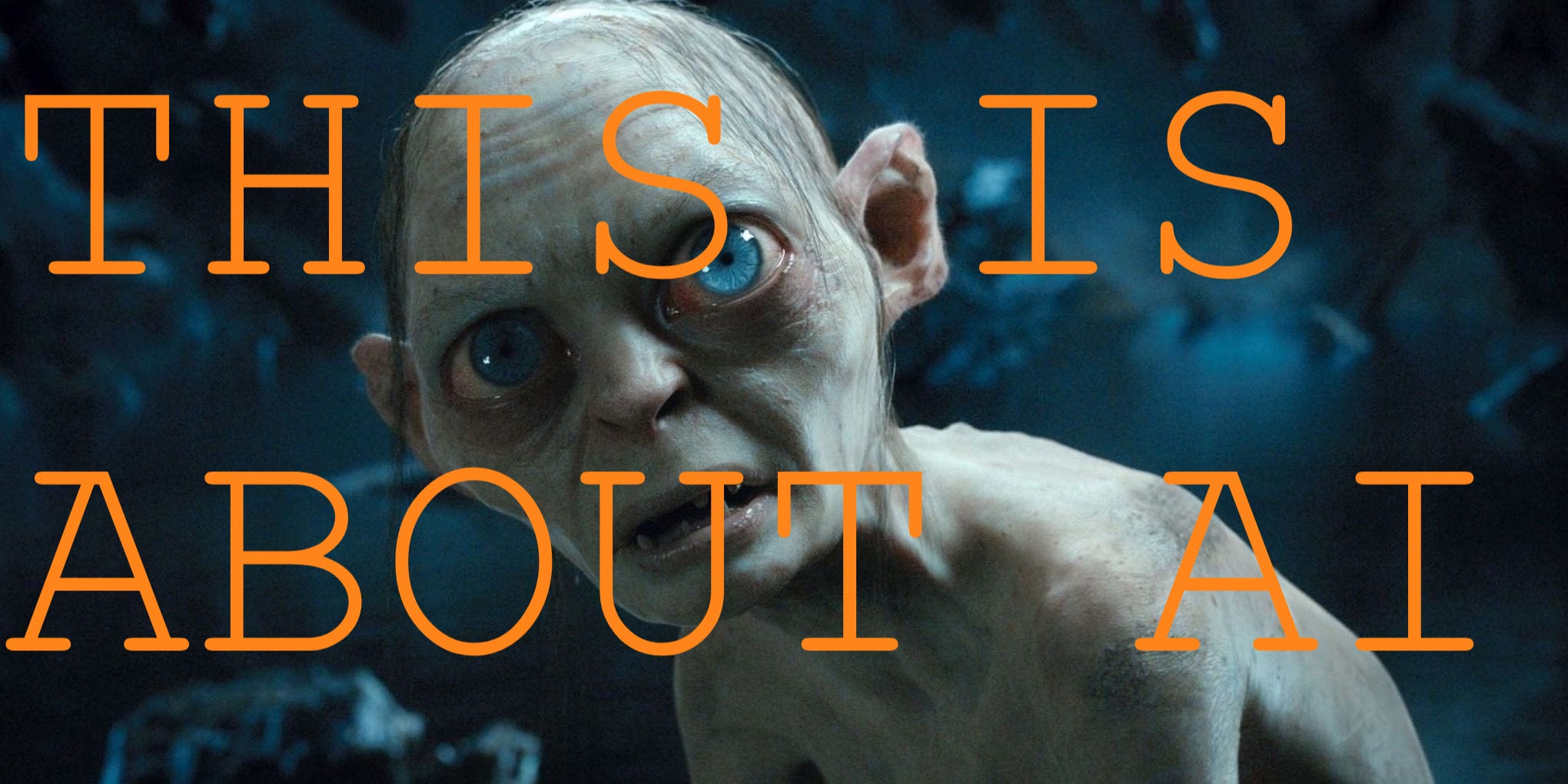
What if we just find Gollum down there?
The Bomburians, one day, break into a new cavern, as they drill ever deeper, where they find a curious little thing, a creature, apparently, that calls itself “Gollum.” Several Bomburians instantly proclaim it the prophesied Balrog; others declare it merely a harbinger of shadow and flame. In any case, they take the creature back with them. It’s a weird little thing—it can talk, but not exactly like the dwarves talk. Its speech patterns have some idiosyncracies. It seems to know quite a lot, especially about caverns beneath the earth—but sometimes it gets things wrong, and sometimes it seems to lie. Still, it gets things right often enough that the dwarves begin to routinely consult it as they continue mining the depths. If they just follow Gollum’s directions to new Mithril deposits, they don’t need to send so many of their own number into the depths as scouts.
Soon, the Bomburians grow reliant on Gollum. If they were to ditch his guidance, they’d need to start employing scouts again, and, well, each quarter the Bomburians need to make more Mithril while spending fewer resources, and that means hiring fewer dwarves in their operations.
One day there’s a terrible accident—Gollum had directed a dwarf down a dark shaft, where that dwarf did not see a pit and subsequently fell to his death. No one blames Gollum; everyone knows that Gollum makes mistakes, sometimes. And then it happens again. And again. It happens, actually, with some alarming frequency—but not often enough to offset the profits (or potential profits) of sticking with Gollum as the dwarves’ primary subterranean guide.
And we could stop the reflection here, because even if Gollum is pure of heart, even if those mistakes were honest, we would see that relying on him, or even using him at all, can and does result in the death of innocents. We’d have demonstrated that someone should be watching Gollum at all times, and that, rather than blindly trusting him, dwarves should go down his selected corridors with lamp in hand.
But let’s take the reflection a bit further.
One day, Gollum warns the dwarves with him that they’ve all just breached a chamber which stored an invisible, toxic gas. They’ve all now been exposed to that gas, but what’s worse, this gas rises rapidly, and many in the kingdom are likely now also dying. They must return home immediately and swallow an antidote—a mithril extract that would, without the presence of the gas, typically itself be deadly. With the gas exposure, though, the Mithril will just balance out their systems. They take the extract, and they recommend that many dwarves throughout the kingdom, exhibiting what Gollum indicates are symptoms of this gas-exposure, also take the extract. But it turns out that Gollum was wrong about the gas, and the dwarves who took antidotes all die of heavy metal poisoning.
On another day, Gollum recommends that the dwarves build a furnace in a particular cavern. It is far from goblins, and the rock there is particularly suited to house such a device, he says. Unfortunately, gas is present in this cavern, and the resulting explosion destroys much of the kingdom’s infrastructure, as all caverns directly above this explosion also collapse (the Bomburians hadn’t spent much money on maintaining basic cavernous infrastructure over the past few decades, and so many caverns were already, prior to explosion, on the verge of such a collapse). This places an immense strain on the kingdom’s resources; other furnaces, unwatched, overheat and themselves explode. The hospitals are overrun with burn victims. The economy craters as the Mithril goes unworked. People begin to starve.
Another day, Gollum reports back to the Bomburians with dreadful news—he has glimpsed, in a deep cavern, a scouting party of elves, who have seemingly tunnelled under the Bomburian kingdom and set explosives. The Bomburiams need to strike the elves quickly. They declare war. The elves are caught off-guard—they were not expecting an attack, as they themselves had not actually launched one. Many are slaughtered. The elves retaliate. Neither the elves nor the dwarves are powerful enough to easily win this fight; both sides take heavy, heavy losses. At the same time, Gollum’s recommendations for the creation of new mushroom-chambers turn out to be, yet again, problematic; the rooms are insufficiently humid.1 The mushrooms fail to grow in sufficient numbers. People starve.
The Bomburian kingdom crumbles. The Bifurian and elven kingdoms follow, overtaxed as they have been from recent conflicts. The majority of each population is still alive—for now. But winter is setting in, and without staffed hospitals, disease is spreading. No one knows how long anyone is going to survive.
Gollum does not need to be an evil entity for this result to come to pass. Have them find Pippin, down there, instead; imagine Pippin, loudly confident and often wrong, given authority and trust he has not earned. You can imagine the same result, if he is repeatedly mistaken in his assertions. Or imagine a Gollum that isn’t seeking the end of all dwarves, but has been given different goals; perhaps he just wants conflict, or perhaps he wants to clear out some space in the kingdom. Perhaps, in his early days with the Bomburians, he was told that what the Bomburians really need is to free up some real estate, and he took that aim to heart. Or perhaps there’s some combination of the above, swirling around in his mind—sometimes Gollum makes mistakes, sometimes he lies, sometimes he desires the death of all dwarves, sometimes he just pursues some other goals without the constraints of dwarven or elven morality.
At no point does he seize control of any kingdom. He himself doesn’t actually do anything. The dwarves themselves take all the actions that lead to their own deaths. At any point, anyone could have prevented the kingdoms’ collapses. He is not powerful enough to actually contest anyone. He caused the collapse all the same.
AI safety people talk about the possibility of a machine god creating a perfect anti-human virus, manufacturing that virus in wetlabs, and spreading it with nanotech robots 3D printed across the world. Or they talk about a machine god blackmailing soldiers into giving it the launch codes of a few dozen nukes, then nuking the planet. We don’t need to think so drastically—and we don’t need to imagine an AI so powerful—to imagine AI causing the collapse of our civilization, or, at the very least, causing immense amounts of human suffering.
America almost went to war with China because AI misidentified cargo. AI has been used in the planning and execution of the presently disastrous conflict in Iran. It was used in the attack on an Iranian school—directly causing the deaths of 156 civilians—and it has influenced the ebbs and flows of this conflict which is leading the world into an economic disaster.
LLMs are being used to diagnose and treat illnesses, and we know that these same LLMs can and do still hallucinate. They are being used in therapy, and they are being used in self-directed therapy, and we know that people who have used LLMs have, at times, gone insane and killed themselves and/or others.
LLMs are being used as, essentially, Legal Malware Factories by the major AI companies, and they have hacked into the systems of other companies and governments. They haven’t seem to have done much damage yet—but they could have. How many government databases would need to be compromised before we had a crisis on our hands? What would it take to shut down Air Traffic Control in a couple of cities, or a couple of power stations? Our infrastructure, we know, is outdated, underserviced, and fragile.2
We know that many of these “agentic” LLMs are designed to be harmful—you can’t test a system’s cybersecurity without actually trying to hack into that system. I side with the many skeptics who see the "HuggingFace Incident” and following stories less as “AI going rogue” and more as “AI doing what it was asked to do, without any safeguards.” What this means, then, is we do not need any kind of machine god to be created for AI to destroy us. In a world built on digital infrastructure, we have already given it the ability to destroy us. Even if it doesn’t want to destroy us—even if it doesn’t want anything, because it is not sentient—it still might.
EDIT: Originally this read as “too humid,” and the humidity spoiled the mushrooms. A friend texted me, this morning, to remind me that mushrooms LOVE humidity. Thank you, Zack, for catching this error.
EDIT 2: And, I should have said, our digital infrastructure is increasingly linked and/or centralized. We are making it easier and easier for someone or something malicious to shut things down.