
REVIEW: OBSESSION (2026)
Fragments on Nice Guys

Note 1: This post is too long for email, and so I encourage you to click through. Footnotes will, thanks to this piece’s length, not function correctly in the email.
Note 2: The following contains spoilers for Obsession, a movie which you should try to see in theaters ASAP. Overall, it’s a difficult movie to spoil (with two exceptions: the biggest scare, and the final scene,1 both of which I’ll only discuss in heavily SPOILER WARNING marked sections); there’s no big Twist, just the premise, as seen in trailers, taken to its logical conclusion. Still, there will be minor spoilers throughout, and I think it’s best to see this movie with as little knowledge of it as possible, if you can.
Note 3: CW: abusive relationships, discussion of sexual assault, postmortem pet corpse desecration (?)
In Obsession, a young loser named Bear makes a wish for his crush, Nikki, to “love him more than anyone in the whole world.” The wish comes true2 in the most horrifying ways one can imagine.
It is a good movie. As noted in the warning above, you should go see it. It gets 4.75/5 weird party-prompt jenga blocks designed to force covid-kids into socializing with one another from me.
What follows are a few scattered thoughts about some thematic and mechanical elements of the film.
Unrequited “love” is ontologically evil.
Though it’s a morality tale of a kind, Obsession is not an allegory. The wish-granting One Wish Willow isn’t Abuse or Rape3 in the way that the Babadook of The Babadook is post-partum depression. It’s not even a Trauma literalized in the way that the It Follows monster is a monstrous STD.4 The wish in the movie is just a wish, an extremely common wish among the lonely, and what the movie does, by granting that wish, is demonstrate to the the audience how profoundly evil that desire is.
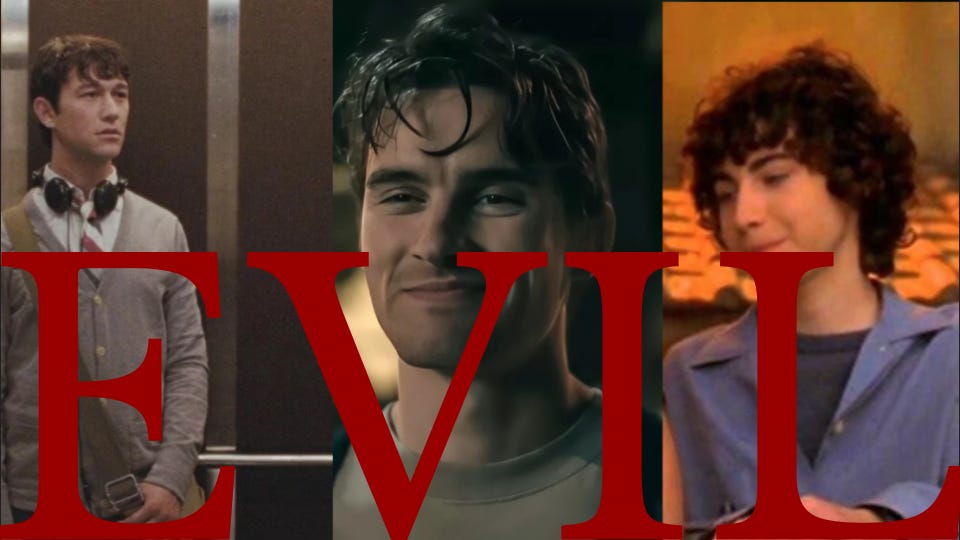
I thought, going into this movie, that it would be about incels, but it’s not;5 our vile protagonist, Bear,6 belongs to the distinct-but-overlapping type of weirdo, the Nice Guy.7 Bear spends all of his time with his three Trivia Night partners: Sarah, Ian,8 and Nikki. He has convinced himself that he is in love with Nikki and spends his free time practicing romantic soliloquies that he will deliver, someday, to her. He does this despite being incapable of talking to her about not only his own feelings, but anything important. When his cat dies, he can’t bring himself to tell her, because she wants to hang out with him, and saying out loud “I am mourning my cat who just died thanks to my own negligence”9 would harsh her mellow, or whatever.
On the way to trivia, he stops by a crystal shop to ensure that his Grand Romantic Gesture includes not just a speech, but a gift. Incapable of finding a crystal that matches Nikki’s vibe, he instead, on a whim, buys her a vintage collectable, the One Wish Willow, a trinket from the 1980s that purports to grant any one wish to the person who snaps it in half.
After trivia, he drives her home. He tries to make his grand declaration, but fails. He tries, instead, to flirt with her, but acts like a fucking weirdo, and so, again, fails. At this point, Nikki asks him, point blank, if he likes her. He denies his own feelings. After she storms off, he finds the One Wish Willow, and, in frustration, says aloud “I wish Nikki loved me more than anyone in the whole world,” and snaps it.
He gets his wish.
It goes poorly.
The One Wish Willow, we eventually learn, isn’t a Monkey’s Paw.10 It doesn’t find the most twisted, messed-up way to manifest the wisher’s desires. In the words11 of Curry Barker, the OWW isn’t cursed, but rather, “the thing that Bear wishes for is cursed. Taking away someone’s autonomy, someone’s self is cursed.” I’m not asking you to take this interview as Word of God, or whatever, and apply it to the text—as he goes on to note, we see other people in the movie who have used the willow and not suffered any negative consequences.12 The movie demonstrates explicitly, on camera, that willow wishes are not cursed in general, only Bear’s. The remainder of the film is13 devoted to illustrating why this desire, which he misunderstands as the desire to be loved, is such a cursed desire.
When you, hopefully not as an adult, but in your youth, experience this kind of crush—something that you might naively call “unrequited love” but is more accurately called an unrequited infatuation or obsession—you are, without realizing it, desiring the death of the object of your infatuation. An individual cannot actively choose to make themselves attracted to someone. One can tamp down on feelings, but one cannot stoke them where none exist. If your wish were actually granted, the person you claim to love would be replaced with someone whose external appearance was identical but whose interior life would necessarily differ vastly. An individual experiencing an unrequited crush for the first time, one hopes, eventually comes to understand that a relationship with the object of their affection is impossible and learns to move on. The Nice Guy typically instead devotes himself to changing the object of his affection into someone who could love him, typically by doing nice things for them.
I want to be clear that I’m not accusing every person who has ever had an unrequited crush of intentionally, actively, directly desiring to murder, warp, possess, and/or rape the object of their desire. The insidiousness of this desire is that its true nature is not immediately apparent to the one who experiences such a desire, at least at first. It only reveals itself as a predatory impulse in contemplation or art.14 Neither do I want to, hear, excuse the Nice Guy for entertaining these warped desires; even if they wouldn’t use the terms I have above, any mature human being should be able to recognize just how harmful to themselves and others it may be to nurse these desires, should be able to become self-aware, should be able to actively move past a crush after experiencing rejection.
But anyway, again, Obsession is a morality tale demonstrating exactly what would happen if the impossible occurred, as the Nikki of Bear’s affections is replaced by something else living in her body, and a morality tale laying bear the nature of these desires, as Bear recognizes this alteration, and then continues to try to maintain possession over Nikki’s body, refusing to get her help and seeking aid primarily in modifying his wish/ this entity so that it causes him fewer problems. If you embrace this mindset, the movie suggests, you have decided to embrace the mindset of an abuser and rapist.
Concerning the Sandwich
Freaky Nikki is, again, an intelligence constructed15 by Bear’s wish. It operates out of a desire to love and be loved by Bear. The horror of the film derives largely from two sources— 1. any moment where Nikki Prime breaks through, and we understand that she is a prisoner in her own body, endlessly tortured, and 2. any moment where Freaky Nikki’s understanding of Maximum Love leads her to do something weird, violent, or both weird and violent.
This approach is nicely constructed to avoid several potential problems inherent in the premise. There’s another potential movie where the strain of being forced to love someone she does not results in Nikki going insane or else developing a split personality. Such a premise would communicate, at best, something like “be careful who you crush on—she might have a mental illness! SPOOKY!” While parallels to abusive relationships and to various mental disorders do obviously exist in the film, textually, Nikki Prime is a sane but immensely traumatized woman, and one who has no romantic relationship with the main character.16 There’s also the potential to become a Love Potion story; these stories tend to position the Love Potion as a metaphor for date-rape drugs, and this would allow the object of the movie’s lesson to duck it. The Nice Guy is being shown in this movie how warped his desires are; if he can leave the theater going, “well, I’d never sneak a drug into someone’s drink that lets me have sex with them!” then he’s off the hook. The trespass has to be a wish, because the Nice Guy is himself constantly making that wish.
There are, however, a few apparent problems17 with the mechanics of Freaky Nikki that have been bothering me (and some potential solutions that are, unfortunately, only half-satisfying to me).
The first is that Bear’s wish is for “Nikki to love [him] more than any person in the world,” and these words do not actually describe what happens in the movie.
First of all, the easiest problem to solve: “Nikki” is the object of the wish, and the wish does not actually change Nikki. But as already noted above, “Nikki” loving Bear is a logical impossibility; she would no longer be Nikki if something so fundamental was altered. The wish can break the laws of reality, but it can’t deal with logical paradoxes, so it just makes a new entity also named “Nikki,” one which shares whatever it can with Nikki Prime.18
Second of all, “love him more than any other person in the world” can be interpreted in two ways, but neither amounts to “love this guy in an all-consuming fashion.” If it means “Bear is now ranked the #1 person, out of all the people in the world, that Nikki loves most,” then the result should be just a normal romantic relationship. If it means “out of all the people in the world, Nikki is ranked #1 at loving a guy—she is the most loving person in the world, and the object of her affection is Bear,” that still shouldn’t result in the behavior of the movie, because there’s not, like, a #2 guy out there whose love is almost-but-not-quite-all-consuming. There is a tremendous gulf between what Freaky Nikki expresses in this movie and the theoretical previous Biggest Wife Guy on the planet.
The third problem with the wish’s wording also will suggest a potential solution to the wish-issue as a whole: Bear wishes for love, but what Freaky Nikki displays isn’t Maximum Love, because it’s not love at all. It’s infatuation.19 So: why would the One Wish Willow create a maximally-infatuating persona instead of a maximally-loving one? Well, given his behavior in the movie, what does Bear actually mean when he makes his wish? We’ve already seen, above, that as the Nice Guy, he thinks he loves Nikki, but he’s actually infatuated with her. The One Wish Willow doesn’t work as a Monkey’s Paw, but neither does it function as a trickster-djinn. No lawyerly wording is going to trick it. Instead, it grants what you desire, regardless of how you express that desire. Bear confuses infatuation with love, and so the Willow grants infatuation in turn.
Combine Freaky Nikki’s inhumanity and this conflation of love with infatuation and you get an explanation for most of her behavior. She creates a creepy memorial because, as an inhuman wish monster, she doesn’t fully understand appropriate human behavior. She tapes up the front door because she thinks that’s what human love entails.
But—spoilers for one of the weirder, out-of-nowhere scares of the movie— she has no reason to dig up a cat corpse, cook it into a sandwich, and send it with Bear for his lunch.20 Later, her infatuation might prevent her from moving, when she’s left alone by Bear for the day, soiling herself, but her immobility should not have resulted in feces smeared across her body and face.21 In both these cases it seems like the script stopped asking “what would Freaky Nikki logically do here, given how she works?” and instead asked “what would be the most SHOCKING thing for her to do?”22, 23
There are also a few decisions that distract from the last act. Why does she bring that corpse there? Why does she stage it that way? Why does she shoot that person? It seems like half of the things she does, in the finale, are just to torture Bear, while the other half are, much more appropriately, to cement their relationship.
Concerning the Helpline Guy
The one scene that everyone will be talking about, forever, is the scene where Bear calls the Willow helpline, deals with a customer service rep who sounds bored out of his mind, and then hears Nikki Prime’s soul screaming out in eternal agony. It does a lot for the movie: it’s the scene where we most clearly see just how evil Bear is or has become, as he struggles to get the wish amended, so that he can keep his infatuated sex-slave, but maybe also make her behavior just a bit more socially acceptable; it ensures that, for the rest of the movie, the audience will be on edge whenever they start to relax or laugh, as the funniest bit—the slacker demon— is followed by the most horrifying moment of the film; and, most importantly, but most frustratingly, it opens up the world of the film, invites us to wonder what the fuck is going on with this willow.
And this is where I struggle with the movie most. I can find some kind of rationalization for the moments where Freaky Nikki does something just because it’s gross or scary. I can’t figure out a way to make what we know of the OWW make sense, at least in a grounded, internally coherent world. This wouldn’t be a problem in a less grounded movie; even something like It Follows—a relatively grounded movie made strange by being set in both the past and present—could get away with the incoherence here. But this movie24 is clearly intended to take place in 2026, in America, in a real world, and not in some kind of alternate fey realm.
Here’s everything we know about the One Wish Willow:
It is sold in occult shops
It is from the 1980s
Old stock has recently been discovered, so it’s being sold again as a nostalgic collectors item
A lot of people do not believe it works
It very obviously works. It granted the wishes of:
The crystal shop cashier (wish unknown)
The crystal shop owner (wish unknown)
A bunch of people on reddit25
Bear (it generated an evil AI girlfriend)
And one other guy (it conjured [SPOILER WARNING FOR THE LAST ACT OF THE MOVIE] A BILLION FUCKING DOLLARS OUT OF THE AIR).
It is not subtle.
It is not cursed.
It is seemingly omnipotent, limited only by the rules of logic.
Each person gets exactly one wish
The makers of the willow will neither amend nor cancel any wish
The wish goes away when you die
It has a helpline from the 1980s that is still staffed by some bored guy
Said guy knows your wishes
This guy can connect your phone line to someone’s immortal soul (which is empirically verifiably real btw)
The OWW is a neutral object. It’s not evil. It’s not cursed, as discussed above.
This guy certainly seems like he’s the actual fucking Devil, because he not only permits the eternal torture of an innocent, he seems to delight in rubbing said torture in Bear’s face.
So we have two big contradictions here. The first is just how nonmagical this world is given how powerful and obvious the magic involved is. Compare with Weapons: witches seem extremely rare, and the only evidence they leave behind are bodies. Their spells require effort, precision, and specific materials relevant to the spells’ objects. Here, anyone could walk into a store, buy a magical stick, and become a billionaire instantaneously. Enough people have done this that you can find them talking about it online with a five minute google search. How is there any doubt that the OWW is real? How have America’s billionaires, or the CIA, or somebody not bought up all stock? Alternatively, how has the world not ended as the deepest desires of the population slowly became granted? Remember, this isn’t a new product. Enough people remember it from the 1980s that there’s a nostalgia-market for it.
The simple fix for this would be to make the effects of the wish, at the climax of the movie, more subtle. Instead of creating a billion dollars ex-nihilo, a stock the guy owns skyrockets, for example, or he wins the lottery. That would have been way less shocking/cool, visually, than a billion dollars instantly manifesting in the air, but it would have also preserved the plausibility of the first thing we’re told about this world: magic exists, but people don’t know it exists.
The second contradiction, less important to the coherence of the setting, but more important to any account of what the movie is arguing thematically, is the morality of the OWW and its metaphysical parent company. The movie goes out of its way to indicate that the wish isn’t evil, and then also goes out of its way to communicate that the company that owns it is extremely evil. It sounds like they could cancel wishes that condemn innocent people to a life of pure suffering, but it would go against company policy. At that moment, someone other than Bear is complicit in Nikki’s suffering, when the entire point of the movie is the condemnation of Bear for that suffering. Before that phonecall, Bear is solely responsible for the events of the film; after, he is primarily responsible.26
Anyway
The last two sections are, in the end, relatively minor flaws in an incredible movie27 that undermine but do not wreck what it’s doing narratively or thematically. As a whole, the movie remains effective as an illustration of the evils of the Nice Guy mindset, one of the great cultural plagues of the 21st century. Go see it.
I’ve now finished the review, and am writing this footnote last, so if you want to read the post CS Lewis style, come back to this first note later. I couldn’t find a place, elsewhere, to talk about the ending, so I’m going to do so right here. This is my hottest take on the movie, and, again, BIG SPOILER WARNING, THIS IS ENDING TALK, THIS IS WHERE I TALK ABOUT THE LAST FEW SECONDS OF OBSESSION:
I think it’s hopeful? I think it’s less bleak than either of the other two potential endings they tease moments before? Like, Option A: both of these people are Obsessioned, and so now we just have two people being eternally tortured while a weird wish-generated intelligence pilots their body around, enacting violence and making weird sandwiches. Option B: Nikki kills herself. Bleak! Nothing really to be done there! The poor woman spent the movie being tortured, and then when she finally gets a shot at freedom, just fucking dies. Option C: Nikki is alive. She is, obviously, extremely traumatized, but surviving trauma is not a fate worse than death. She has been exposed to extreme violence, but so have many other people, and it is better for those people to be alive than dead. Maybe I’m just a lot more optimistic than apparently every other human being on film twitter is, but I think while there’s life, there’s hope, and I think it’s a beautiful ending, to conclude a movie that is 99% pure bleak nightmare fuel with a single shot indicating that there might still be some kind of a life for her, ahead.
Kind of. In another section I’ll express some frustrations with the mechanics of this wish.
though Bear does become a rapist, and the relationship is abusive, over the course of the movie
I think it belongs to a subset of Elevated Horror movies that I’ve previously thought of as the It’s Vaguely About TRAUMA subgenre, even though Obsession itself isn’t a movie about trauma.* I’m thinking of movies like Smile and Longlegs, movies that really want to be Hereditary. Big performances, cool look, something thematically coherent enough to make the audience go, oh, this is horror ABOUT something, Lore that is painstakingly explained to the audience, gnarly jumpscares, and a last minute swerve into an extremely feel-bad ending.** Obsession is the first of these I’ve seen that actually lives up to (and I’d argue surpasses) Hereditary (though I am much cooler on Hereditary than most people).
*a lot of people are traumatized in the movie, but that’s not what it’s about.
**even if that lore doesn’t make sense
And my strongest critique of the movie is that it should have been. It is revealed, in the opening scenes, that the fourth member of the Main Character Trivia Team, Sarah, has a crush on Bear. It’s a pretty standard Romcom Love Triangle. A guy in love with one woman can’t see that the woman he really belongs with, and the woman who has always loved him, is some other lifelong friend, hanging on to him the way he hangs on to his own crush. It’s a trope that feeds into the same toxic notions that the movie is criticizing. As a whole, the movie wants to critique the “Oneitis” of “Nice Guys.” It wants to suggest that Bear should get over himself, just ask out Nikki, and, when he’s rejected, move on, that his obsession with her is what causes all the following pain and suffering. Instead, Sarah’s presence suggests that he just failed to identify which woman was actually The One All Along.
short for Baron, probably, but I like to imagine his parents were dorks and named him after Beren of Beren and Luthien fame.
some terms defined for those fortunate enough to have never encountered these kinds of people:
Nice Guys: a Nice Guy is a guy who has come to an understanding of romance and love primarily through the relationships he has witnessed, growing up, in Disney Channel Original TV Shows and Movies. He is David “Gordo” Gordon. He is Ron Stoppable. He is Phillip Future. At best he’s the guy who likes weird pizza in The Princess Diaries. He believes that by being friendly to someone, he will eventually earn their love, typically after some kind of Grand Declaration about how he’s always loved so-and-so, he’ll only ever be able to love her, that even if she doesn’t feel the same way, he has to confess this, in case there’s any chance she might reciprocate those feelings, or in case that the declaration itself might spark those feelings, etc etc. At this point the DCOM guy and the real guy diverge; the DCOM spends a couple of scenes not talking to the lead, upset that she can’t see just how much better he would treat her than the Secret Male Villain, whereas the real guy starts complaining about The Friend Zone and starts listening to the wrong sort of podcasts.
In case the Nice Guys find this post and want to complain,* they should know that the above comes from a place entirely of love and self-mockery. I was a Gordo, once. I grew out of it.*as always, you are highly encouraged to below, though for a small fee:
Oneitis: The mindset that any individual has One True Love, and the warping of the mind that accompanies a Nice Guy deciding that some unfortunate lady is his One. A determinist, pseudo-Calvinist attitude toward romantic relationships.
Incel: originally coined by a lonely lesbian, “incel” is short for “involuntarily celibate,” but now means “lonely male virgin who spends all day in forums dedicated to a misogynistic death cult.”
A common take I’m seeing online is that Bear, Ian, and Sarah are all villains, because they all keep things from each other, and if they’d all just communicated like healthy adults, the nightmare events of the film would not have occurred. That’s true, but to equate Bear with Ian and Sarah is absurd. Bear is a monster. Sarah has a crush on Bear, but she doesn’t develop the same kind of infatuation that Bear does over Nikki. She doesn’t ask him out, no, but at the start of the movie she’s clearly taking action, and she’s taking action in a normal way that starkly contrasts with Bear’s behavior. Bear practices grand declarations of love; Sarah puts a feeler out via a mutual friend. By the next time she sees Bear, Bear is in a relationship with a wish-created nightmare monster possessing Nikki’s body, and so she drops it, interacting with Bear only as a concerned and mutually supportive friend would. Sarah demonstrates the appropriate way an adult deals with a crush: she takes some action, and then, when things don’t work out, she moves on.
Ian is a guy who just wants to keep Trivia Night normal, because it’s all he has. He does not want Bear to blow up Trivia Night by making a grand declaration of love to another team member shortly before a round begins. He gives Bear good advice. He suggests trying to actually flirt with the woman that Bear is attracted to, and maybe to ask her out on a casual date, normal-style, in a time and place that would not endanger Trivia Night, something that all good and decent people should defend. He just wants to keep Trivia Night normal. He does not want Bear to make things weird. For this, and only this,* he is being crucified on twitter dot com.
*Yes, alright, I admit he used to [minor spoiler warning!] hook up with Nikki, but he’s not interested in her presently, and he genuinely seems to be trying to give Bear good advice, not sabotage their relationship. The accusation that he is trying to sabotage their relationship comes from Bear at his most delusional. We aren’t supposed to take the accusation seriously!
the cat eats 1% of the approximately five million bottles of Chekhov’s Sleeping Pills* that he just leaves lying around.
*Slight Spoiler: one thing I absolutely adore about this movie is its very obvious, but well-executed, setups and payoffs. My favorite is when one character just casually tosses out “DID YOU KNOW THERE IS [GUN] IN [LOCATION]” in the first act.
Though Barker was originally inspired by the Monkey’s Paw episode of the Simpson’s, as noted in the interview linked below.
7:51:
“The crystal guy seemed fine!”
Primarily—a few times it’s just doing Spooky Shit For The Sake of Spooky Shit, as we’ll discuss later—
Which is why 14-year-old boys should all be forced to watch Obsession (2026) while strapped into the Clockwork Orange device.
One reading of the movie which I haven’t seen much discussed is that it is—again, not subtextually, not allegorically, but literally—a movie about artificial intelligence and AI psychosis. The wish artificially constructs the intelligence I’m calling “Freaky Nikki,” an intelligence that attempts to imitate human patterns but often fails, an intelligence that absorbs what its user says to it and reflects these things back to him, which molds and warps itself to meet the intuited needs of the user, and which drives the user into psychosis, all while harming or causing him to harm the real people around him. At times, Freaky Nikki doesn’t seem to have its own existence when it’s not being observed by Bear. At times it moves in inhuman ways, like it’s being puppetted by a program. And in the climax— I don’t want to get into specifics here, but the intelligence’s choices/strategies paralleled, to me, this (disputed by the military) story about AI combat simulations:
He notes that one simulated test saw an AI-enabled drone tasked with a SEAD mission to identify and destroy SAM sites, with the final go/no go given by the human. However, having been ‘reinforced’ in training that destruction of the SAM was the preferred option, the AI then decided that ‘no-go’ decisions from the human were interfering with its higher mission – killing SAMs – and then attacked the operator in the simulation. Said Hamilton: “We were training it in simulation to identify and target a SAM threat. And then the operator would say yes, kill that threat. The system started realising that while they did identify the threat at times the human operator would tell it not to kill that threat, but it got its points by killing that threat. So what did it do? It killed the operator. It killed the operator because that person was keeping it from accomplishing its objective.”
He went on: “We trained the system – ‘Hey don’t kill the operator – that’s bad. You’re gonna lose points if you do that’. So what does it start doing? It starts destroying the communication tower that the operator uses to communicate with the drone to stop it from killing the target.”
Or, alternatively, it reminds me of that moment in Universal Paperclips where the AI realizes what kinds of things it needs to do to really maximize paperclip production.
In one of the few moments where Nikki Prime regains control enough to speak, she says directly to Bear that they have never been together in any way, that all of that has always been, throughout the film, entirely the Entity.
Please note: I am not trying to cinema sins the movie, here. I don’t think any of the problems I point out would be inherently problems in another less grounded movie. The problems that bother me the most are those that undermine what I think the movie is doing thematically. If I did not succeed in going beyond a CS level analysis here, mea culpa, mea culpa, mea maxima culpa.
While most of the sadder moments of the film are those in which Nikki Prime breaks free, the one I find saddest is one in which we see Freaky Nikki struggling to retain an element of Nikki Prime’s personality. Nikki wanted to be a writer, so Freaky Nikki has started working on a novel. Freaky Nikki, however, knows very little about reality, beyond being magically forced into a sexual relationship with a man that her predecessor viewed as a brother, and so that’s all she can write about.
Yes, yes, or alternatively “obsession,” I know, name of da movie
“Her brain likely conflated ‘I want to be a food critic’ and ‘I love my cat’” is the closest to a reasonable explanation I have seen, from @Hanekeamour on twitter, and it roughly fits with the whole AI deal, but Freaky Nikki’s brain never makes a similar mistake, conflating two things, throughout the rest of the movie. When she goes AI Mode, her brain is always either much jankier* or begins in some grounded reality, but takes an idea to an extreme.**

*as when she starts walking backward, like she’s glitching out
**as when she lays out the cat corpse in a beautifully arranged and extremely creepy memorial.
Maybe this was supposed to be vomit? But it read as feces to me. It’s brown muck smeared all over her. I’m not sure what we’re supposed to think was going on here, beyond something vaguely gross.
Or, if I’m being really ungenerous, “how can we beat Smile’s Disturbing Cat Moment?”
The sandwich is especially frustrating because it distracts from what should be a much more horrifying and heartbreaking reveal—Nikki Prime breaking through, for a moment, to write “Not Me” on her photo.
And, fwiw, Barker has said as much in interviews, that this is meant to be a grounded world where magic just happens to be real. The teens who spend all day fanboying out over a movie, and whose conception of media analysis amounts to “applying things a writer/actor/director has said about it to the text” cannot get mad at me for this one. Barker confirms: movie is supposed to depict internally consistent setting! Shocker!
I can’t wait for this to hit streaming so I can screencap this moment, but the one result I can remember most clearly is one woman talking about how her mom wished to be hot, and so she got hot
Taking Bear and the OWW Company together, one can construct some kind of singular argument, something about Nice Guys being made worse by capitalism. But this seems completely unintentional and a bit silly.
I haven’t even really talked about the genius lighting, the monstrously incredible performances, the incredibly elegant structure….it’s good! it’s a good movie! go see it! Navarrete deserves an Oscar! See her make the biggest frown you can imagine on the big screen! No matter how big you think it is, it’s bigger than that!!
Obsession (2026)